How Much Should I Squat – What the Numbers Actually Say
If you’ve ever wondered how much should I squat, you’re not alone. It’s one of the most common questions that shows up in every gym conversation, and rightly so. The squat is the most honest test of lower body strength you’ll ever run into.
The short answer? It depends on your bodyweight, your experience level, and how long you’ve been training. But that’s not very useful on its own, so let’s break it down properly.
According to StrengthLog, which has aggregated data from over 18 million logged squat lifts, the average man squats around 265 lbs and the average woman around 154 lbs. Those numbers put you squarely in intermediate territory. But “average” is not the goal for most people reading this.
Why the Squat Is Non-negotiable
The squat works quads, glutes, hamstrings, core, and lower back all at once. No other exercise packs that much return per rep. That’s why it shows up in every serious strength program – from Jim Wendler’s 5/3/1 to basic beginner routines.
Beyond raw strength, squatting with good form improves hip mobility, knee stability, and posture. Skip it long enough and those weaknesses will eventually show up elsewhere.
The goal isn’t to chase a specific number just to say you hit it. The goal is to move well, add weight consistently, and stay injury-free while doing it.
Squat Standards for Men by Experience Level
These standards are based on bodyweight ratios, which is the most practical way to measure squat strength. A 150 lb man and a 220 lb man will naturally lift different amounts, but comparing them to their own bodyweight tells you where each actually stands.
| Level | Experience | Bodyweight Ratio | Example (180 lb man) |
|---|---|---|---|
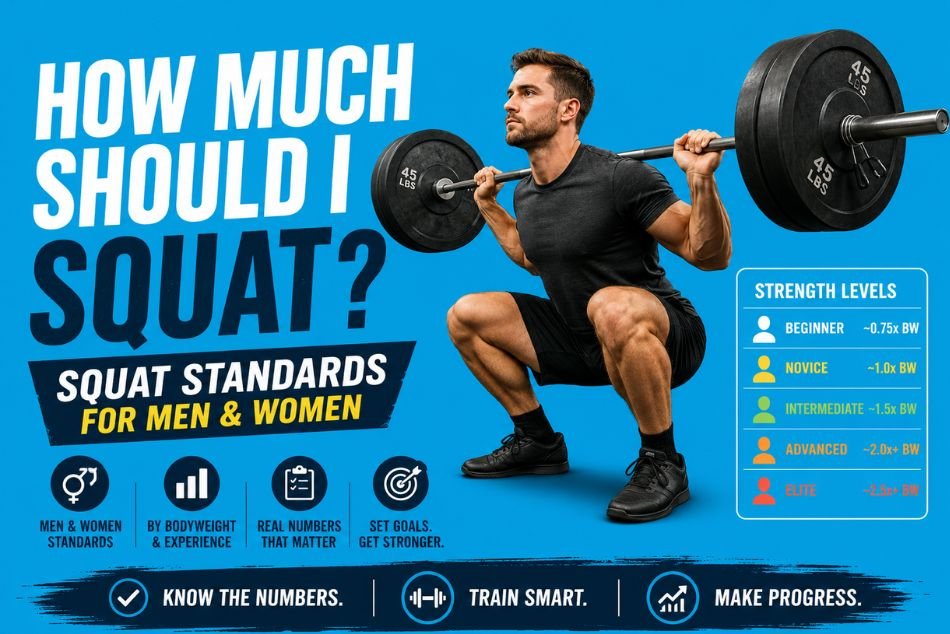
| Beginner | 0–6 months | ~0.75x BW | ~135 lbs |
| Novice | 6–12 months | ~1.0x BW | ~180 lbs |
| Intermediate | 1–3 years | ~1.5x BW | ~270 lbs |
| Advanced | 3–5 years | ~2.0–2.25x BW | ~360–405 lbs |
| Elite | 5+ years | ~2.5–2.75x BW | ~450–495 lbs |
For most guys training consistently for a year or two, hitting 1.5x bodyweight is a solid, realistic target. Getting to 2x bodyweight takes several years of structured, progressive training – it’s not something you stumble into.
A 225 lb squat for a 180 lb man is respectable and puts you solidly in the novice-to-intermediate range. Nothing to be ashamed of, and plenty of room to build from there.
Squat Standards for Women by Experience Level
Women’s squat standards use a different scale. Structural differences in hip width, femur length, and overall muscle mass distribution mean direct comparisons to male standards don’t make sense.
| Level | Experience | Bodyweight Ratio | Example (140 lb woman) |
|---|---|---|---|
| Beginner | 0–6 months | ~0.5x BW | ~70 lbs |
| Novice | 6–12 months | ~0.75x BW | ~105 lbs |
| Intermediate | 1–3 years | ~1.25x BW | ~175 lbs |
| Advanced | 3–5 years | ~1.5–1.75x BW | ~210–245 lbs |
| Elite | 5+ years | ~2.0x BW | ~280 lbs |
A 140 lb woman squatting 175 lbs is doing well. That’s intermediate territory and takes consistent, dedicated training to reach.
Female beginners often start with just the bar or lighter loads. That’s completely normal. The early weeks are about nailing form, not chasing numbers.
How Much Should I Squat Based on Body Weight?
If you want a specific number to aim for, how much should I squat really comes down to your exact bodyweight and where you are in your training. The tables below are based on data from Symmetric Strength, one of the most widely referenced lift standards databases used by coaches and competitive lifters.
All numbers are 1-rep max (1RM) estimates in pounds. Find your bodyweight row and read across to see where you stand.
Male Squat Standards by Body Weight (Lbs) — Source: Symmetric Strength
| Body Weight | Untrained | Novice | Intermediate | Proficient | Advanced | Exceptional | Elite | World Class |
|---|---|---|---|---|---|---|---|---|
| 114 lbs | 95 | 140 | 185 | 230 | 270 | 310 | 345 | 385 |
| 123 lbs | 100 | 150 | 200 | 250 | 290 | 335 | 375 | 415 |
| 132 lbs | 105 | 160 | 215 | 265 | 310 | 355 | 400 | 445 |
| 148 lbs | 120 | 175 | 235 | 295 | 345 | 395 | 440 | 490 |
| 165 lbs | 130 | 190 | 255 | 320 | 375 | 425 | 480 | 535 |
| 181 lbs | 135 | 205 | 270 | 340 | 395 | 455 | 510 | 565 |
| 198 lbs | 145 | 215 | 285 | 355 | 415 | 475 | 535 | 595 |
| 220 lbs | 150 | 225 | 300 | 375 | 435 | 500 | 560 | 625 |
| 242 lbs | 155 | 235 | 310 | 390 | 450 | 515 | 580 | 645 |
| 275 lbs | 160 | 240 | 320 | 400 | 465 | 535 | 600 | 670 |
| 320 lbs | 165 | 245 | 330 | 410 | 480 | 550 | 615 | 685 |
Female Squat Standards by Body Weight (Lbs) — Source: Symmetric Strength
| Body Weight | Untrained | Novice | Intermediate | Proficient | Advanced | Exceptional | Elite | World Class |
|---|---|---|---|---|---|---|---|---|
| 97 lbs | 65 | 100 | 130 | 165 | 190 | 220 | 245 | 275 |
| 105 lbs | 70 | 105 | 140 | 175 | 200 | 230 | 260 | 290 |
| 114 lbs | 75 | 110 | 145 | 185 | 215 | 245 | 275 | 305 |
| 123 lbs | 80 | 115 | 155 | 195 | 230 | 260 | 295 | 325 |
| 132 lbs | 85 | 125 | 165 | 205 | 240 | 275 | 310 | 345 |
| 148 lbs | 90 | 135 | 180 | 225 | 260 | 300 | 335 | 375 |
| 165 lbs | 95 | 145 | 195 | 240 | 285 | 325 | 365 | 405 |
| 181 lbs | 100 | 155 | 205 | 255 | 300 | 340 | 385 | 425 |
| 198 lbs | 105 | 160 | 215 | 265 | 310 | 355 | 400 | 445 |
| 200 lbs | 105 | 160 | 215 | 270 | 310 | 355 | 400 | 445 |
Keep in mind these are 1RM benchmarks. Your working sets at 5 reps or 10 reps will use less weight — typically around 75–85% of your 1RM depending on the rep range.
Also worth noting: world-class numbers are for competitive athletes who’ve dedicated years specifically to the squat. Don’t use that column to judge yourself unless you’re on a platform.
Factors That Affect Your Squat Numbers
Two people the same weight and age can squat very different amounts. It’s not random – here’s what actually drives the difference.
- Limb Length and Hip Structure: Longer femurs force a more forward lean in the squat, which changes muscle recruitment and often makes the movement harder. It’s not a weakness – it’s anatomy. Some people will always have to work harder for the same number on the bar.
- Training Age: How long you’ve been consistently lifting matters more than almost anything. Someone who’s trained properly for three years will outperform someone who’s trained casually for ten. Consistency beats time.
- Sleep and Nutrition: You don’t build strength in the gym – you build it recovering from the gym. Chronically under-eating or sleeping less than 7 hours a night will put a hard ceiling on your progress, no matter how hard you train.
- Technique: Good form isn’t just about safety – it’s about efficiency. A lifter with solid mechanics will always move more weight than one who fights the bar. This is worth spending real time on, especially in your first year.
- Program Quality: Random workouts done consistently will still produce results, but a structured progressive program will outperform them. Beginner linear programs like StrongLifts 5×5 or the 5/3/1 method work because they force you to add weight on a schedule, not just when you feel like it.
Common Squat Mistakes That Keep Your Numbers Low
Most people who plateau on their squat aren’t hitting some genetic ceiling. They’re making one of these avoidable mistakes.
- Ego Loading: Piling on more weight than your technique can handle does one thing: it teaches you how to squat badly. Depth goes, knees cave, lower back rounds – and none of it counts as a real squat. Drop the weight, fix the movement, and the numbers will come.
- Skipping Depth: A squat only counts when your hip crease drops below the top of your knee. Quarter squats might feel impressive on paper, but they don’t train the full range of motion and they won’t transfer to real strength. Full depth, every rep.
- Neglecting Accessory Work: Weak glutes, tight hip flexors, and underdeveloped hamstrings all limit the squat. Adding targeted accessory work – Romanian deadlifts, hip thrusts, leg curls – removes the weak links.
- No Progressive Overload: If you’re squatting the same weight you were squatting six months ago, you’re not training – you’re just maintaining. The body adapts to stress. You have to keep increasing it, even if that means adding just 5 lbs at a time.
How to Improve Your Squat – Practical Starting Points
Once you know how much should I squat for my level, the next step is actually getting there. Here’s what works.
- Train the Squat 2–3 Times per Week: Frequency is your friend, especially early on. Squatting twice or three times a week builds the motor pattern faster and compounds strength gains quicker than once-a-week sessions.
- Use a Proven Program: Don’t improvise your progression. A simple, structured program removes the guesswork. For raw strength, Jim Wendler’s 5/3/1 method – which we’ve broken down fully at spcfitz.com – is one of the most reliable options around for intermediate lifters.
- Video Your Sets: You can’t feel what your squat looks like. Recording a set from the side every few weeks gives you honest feedback on depth, bar path, and knee tracking that no mirror can provide.
- Address Mobility Limitations: If your ankles or hips restrict your depth, no amount of mental effort will fix it. Spend 5–10 minutes before each session on hip flexor stretches, ankle circles, and goblet squat holds at depth. Over weeks, this compounds.
- Add Weight Slowly and Consistently: The biggest mistake in strength training isn’t going too slow – it’s jumping too fast. Adding 5 lbs to your lower body lifts per week is 260 lbs in a year. That’s not small. Let it compound.
Squat Depth and Safety – What You Need to Know
Proper squat depth means hitting at least parallel – hip crease in line with or below the top of the knee. This is the standard used in powerlifting and the standard that makes the squat actually work.
Knee pain during squats is often a technique issue, not a structural one. Knees tracking inward, heels rising, or excessive forward lean are fixable. A form check from a coach or experienced lifter can save you months of frustration.
If you’re returning from injury, work with a physiotherapist before loading up. There’s no rush. A healthy year of training beats three months of heavy squatting followed by six months on the sidelines.
Wrapping Up
So, how much should I squat? The honest answer is: more than you can today, less than you’ll be able to next year.
Use the standards in this guide as a compass, not a verdict. A beginner man squatting 0.75x his bodyweight is exactly where he should be. An intermediate woman hitting 1.25x hers is making real progress. Numbers only matter in context.
What matters most is that you’re squatting consistently, adding weight over time, prioritizing depth and form, and recovering properly. The numbers follow from that – every time.
FAQs
Q1) Is Squatting 225 Lbs a Good Squat?
For a man around 180 lbs, 225 lbs is a respectable novice-to-intermediate squat. For a lighter lifter, it’s solid intermediate territory. Context matters more than the raw number.
Q2) Is a 1.5x Bodyweight Squat Impressive?
For most people, yes. Hitting 1.5x bodyweight consistently with full depth puts you in solid intermediate territory. For a 180 lb man, that’s a 270 lb squat – something that takes genuine, consistent effort to build.
Q3) How Long Does It Take to Double Your Bodyweight Squat?
Realistically, 4–6 years of structured, consistent training for most people. Some lifters get there faster depending on starting strength, body type, and program quality, but don’t expect it to happen in a year.
Q4) Can I Squat Every Day?
Daily squatting is possible but not necessary or helpful for most people. Training the squat 2–3 times per week gives most lifters plenty of stimulus with enough recovery between sessions. Quality and progression matter more than frequency.
Q5) Does Body Weight Affect How Much I Can Squat?
Heavier lifters can typically lift more in absolute terms, which is why bodyweight ratios are the better comparison. A 250 lb man squatting 300 lbs is actually weaker relative to his size than a 160 lb man squatting 240 lbs.
Q6) What Is Considered an Elite Squat?
For men, elite is generally considered 2.5–2.75x bodyweight. For women, around 2.0x bodyweight. These levels require years of dedicated training and represent the top tier of recreational and competitive strength athletes.