What Are V Lines and Why They Matter in Aesthetics
If you’ve ever looked at a lean, athletic physique and noticed those sharp lines running from the hips down toward the lower abs, you’ve already seen what people are referring to when they ask what are V lines.
V lines, often called the Adonis belt, are one of the most visually striking features of a well-conditioned body. They form a V-shaped groove that connects the lower abdominal region to the pelvic area, giving the torso a tapered, aesthetic look.
But here’s the important part—V lines are not a muscle group you can isolate and build like biceps or chest. They are a visual outcome. They show up when your body reaches a certain level of leanness and muscular development.
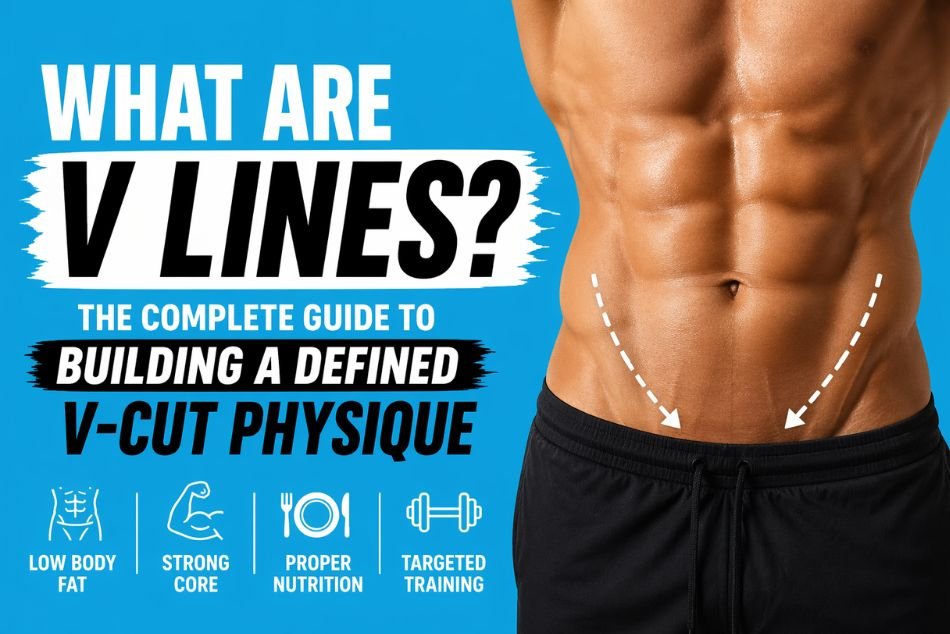
This is why they are often associated with advanced physiques. Anyone can build muscle, but not everyone gets lean enough or trains strategically enough to reveal this level of detail.
The Anatomy Behind V Lines: What Actually Creates That Look
To understand how to develop V lines, you need to understand what’s happening beneath the skin.
The V-cut is created by a combination of:
- External Obliques: These muscles run diagonally along the sides of your torso. They are the primary contributors to the V shape.
- Lower Rectus Abdominis: The lower portion of your abs adds thickness and separation.
- Transverse Abdominis: This deep core muscle pulls your waist inward, making the V more pronounced.
- Inguinal Ligament Area: This is where the visible “line” actually forms when fat levels are low.
When these structures are developed and body fat is reduced, the lines become visible. Without both factors, they remain hidden.
Why V Lines Are So Hard to Achieve
A lot of people assume that doing more ab exercises will automatically lead to V lines. That’s where most go wrong.
V lines are difficult because they depend heavily on:
- Low body fat levels
- Stubborn fat distribution
- Consistent long-term discipline
The lower abdominal region is one of the last places where the body loses fat. Even if your upper abs are visible, your V lines may still be hidden.
This is why people often get stuck. They think they are close, but they’re actually still a few percentage points away from the required leanness.
Body Fat: The Real Key to Visible V Lines
If there’s one thing you should take seriously from this entire guide, it’s this:
You don’t “build” V lines—you uncover them.
Your body fat percentage determines whether those lines show or not.
Typical visibility ranges:
- Men: Around 10–12% for clear V lines
- Women: Around 15–18% for visible definition
At higher body fat levels, even strong obliques won’t show clearly.
This is why fat loss is the foundation of achieving the V-cut look.
The Myth of Spot Reduction
Let’s clear this up directly.
You cannot burn fat specifically from your lower abs or hip region by doing targeted exercises.
No matter how many:
- Crunches
- Leg raises
- Twists
you do, fat loss will still happen across your entire body—not just one area.
This is controlled by your overall calorie balance and genetics.
So if your plan is to “target” V lines with ab workouts alone, it won’t work.
Genetics: The Factor You Can’t Ignore
Genetics play a bigger role than most people like to admit.
Some individuals:
- Naturally store less fat in the lower abdomen
- Have deeper muscle separations
- Show definition earlier
Others:
- Hold stubborn fat in the lower belly
- Have flatter abdominal structures
- Require more effort to achieve the same look
This doesn’t mean you can’t get V lines. It just means your journey might take longer or look slightly different.
Building the Right Foundation: Strength Before Definition
Before chasing extreme definition, you need to build a solid core.
A weak core will never produce a sharp V-cut, even at low body fat.
Your goal should be:
- Strong obliques
- Controlled lower abs
- Stable core
This creates the “structure” that will later become visible.
Best Exercises to Develop V-Line Muscles
Now let’s talk about training the right way.
1) Hanging Leg Raises
One of the most effective movements for lower abs.
- Focus on slow, controlled movement
- Avoid swinging
- Engage your core, not momentum
2) Cable Woodchoppers
Excellent for building oblique thickness.
- Rotate through your torso
- Keep tension throughout the movement
3) Reverse Crunches
Great for isolating lower abs.
- Lift your hips slightly off the ground
- Focus on contraction, not speed
4) Side Planks
Targets deep core muscles.
- Improves stability
- Helps tighten the waist
5) Decline Bench Leg Raises
Adds intensity to lower ab work.
- Control the eccentric phase
- Avoid using hip flexors excessively
Training Frequency: How Much Is Enough?
Training abs every day is not necessary.
Optimal approach:
- 2 to 3 sessions per week
- 3 to 4 exercises per session
- Focus on quality reps
Your abs need recovery just like any other muscle group.
Overtraining can reduce performance and slow progress.
Progressive Overload for Abs (Most People Ignore This)
If you want your abs to grow and become more defined, you need progression.
This can be done by:
- Increasing reps
- Adding resistance (weights, cables)
- Slowing down tempo
- Improving form
Doing the same routine every week without progression will limit results.
Nutrition Strategy to Reveal V Lines
Training builds the muscle, but nutrition reveals it.
Calorie Deficit
You must consume fewer calories than you burn.
Without this, fat loss will not happen.
Protein Intake
High protein helps:
- Preserve muscle mass
- Improve recovery
- Increase satiety
Balanced Diet
Include:
- Complex carbs for energy
- Healthy fats for hormone balance
Consistency
This is more important than perfection.
A sustainable diet will always outperform an extreme one.
Cardio: Necessary or Optional?
Cardio is not mandatory, but it’s highly useful.
It helps:
- Increase calorie expenditure
- Speed up fat loss
- Improve overall fitness
Even simple activities like daily walking can make a noticeable difference.
The Role of Lifestyle in Achieving V Lines
Most people focus only on training and diet, but lifestyle matters too.
Sleep
Poor sleep can:
- Increase fat storage
- Reduce recovery
- Affect hormones
Aim for 7–8 hours per night.
Stress Management
High stress levels can:
- Increase cortisol
- Promote fat retention
Managing stress improves fat loss efficiency.
Common Mistakes That Delay Progress
- Focusing Only on Abs: Ignoring overall fat loss slows everything down.
- Inconsistent Diet: Even small daily excess calories can stop fat loss.
- Lack of Patience: Lower belly fat takes time to reduce.
- Poor Exercise Form: Using momentum instead of muscle reduces effectiveness.
- Unrealistic Expectations: Comparing yourself to edited or peak-condition physiques can be misleading.
How Long Does It Take to Get V Lines?
There is no universal timeline.
It depends on:
- Starting body fat
- Diet consistency
- Training intensity
General estimates:
- Already lean: 4–8 weeks
- Moderate body fat: 2–4 months
- Higher body fat: 4–6+ months
Consistency is what determines speed.
Sample Weekly Plan for V-Line Development
Day 1
- Hanging Leg Raises – 3 sets
- Russian Twists – 3 sets
- Plank – 3 sets
Day 2
- Cable Woodchoppers – 3 sets
- Reverse Crunches – 3 sets
- Side Plank – 3 sets
Day 3 (Optional)
- Mixed circuit with lighter intensity
Combine this with full-body training and a proper diet.
Why V Lines Are Considered Advanced Aesthetics
Many people can develop visible abs.
But V lines require:
- Lower body fat
- Better muscle detail
- Greater discipline
They are often one of the last features to appear, which is why they’re seen as a higher-level aesthetic goal.
Are V Lines Worth the Effort?
That depends on your goal.
If your focus is:
- Aesthetic physique
- Fitness modeling
- Bodybuilding
Then yes, they’re worth pursuing.
But they should never come at the cost of:
- Health
- Sustainability
- Balance
They are a result—not the purpose.
Wrap-Up: What Are V Lines and How You Should Approach Them
By now, you should have a complete understanding of what are V lines and what it really takes to achieve them.
They are not built through shortcuts or quick fixes. They are revealed through a combination of low body fat, strong core development, proper nutrition, and long-term consistency.
If you focus only on ab workouts, you’ll miss the bigger picture. But if you train smart, eat right, stay patient, and stay consistent, the V-cut will develop naturally over time.
Instead of chasing the result directly, build the habits that lead to it. That’s what ultimately separates those who get V lines from those who don’t.
FAQ: What Are V Lines and How to Get Them
Q1) What Are V Lines in Fitness?
V lines are the two diagonal lines that appear on the lower abdomen, running from the hips toward the pelvis. If you’re wondering what are V lines, they are formed where the obliques and deeper core muscles meet and become visible when body fat is low.
Q2) Are V Lines the Same as a Six-Pack?
No, they are different. A six-pack refers to the rectus abdominis (front abs), while V lines come from the obliques and lower abdominal region. Both are part of a strong core, but V lines usually require a leaner physique to become visible.
Q3) What Body Fat Percentage Is Needed to See V Lines?
For most people, V lines become visible at:
- Around 10–12% body fat for men
- Around 14–18% body fat for women
The exact percentage varies based on genetics and muscle development.
Q4) Can Everyone Develop V Lines?
Yes, everyone has the underlying muscle structure. However, how visible they become depends on factors like body fat levels, muscle development, and genetics. Some people may achieve deeper definition than others.
Q5) What Are V Lines Exercises That Actually Work?
If you’re trying to understand what are V lines and how to train for them, focus on exercises that target the lower abs and obliques, such as:
- Hanging Leg Raises
- Crossbody Mountain Climbers
- Oblique Jackknifes
- L-Seated Knee Tucks
- Stomach Vacuums
These help strengthen the muscles that form the V-cut.
Q6) Can I Get V Lines Without Losing Fat?
No, fat loss is essential. Even if you have strong abs, V lines won’t be visible unless your body fat is low enough to reveal them. A calorie deficit and consistent diet play a major role.
Q7) How Long Does It Take to Get V Lines?
It depends on your starting point. If you already have low body fat, it may take a few weeks. If not, it can take several months of consistent training and dieting.
Q8) Are V Lines a Sign of Good Fitness?
Yes, they are often considered a sign of a lean and well-conditioned body. When people ask what are V lines, they’re usually referring to this level of definition that reflects both low body fat and strong core muscles.