A Quick Guide on How to Get Bigger Legs Without Wasting Months in the Gym
Walk into any gym on a Monday and you’ll see the bench packed three deep. Walk in on leg day and it’s you, one other guy, and a squat rack nobody’s touched. If you’ve been chasing bigger legs for a while without much to show for it, the problem usually isn’t genetics. It’s that most people never actually learn how to get bigger legs the right way, so they end up doing 20 minutes on a leg extension machine and calling it a day.
Bigger legs come from the same handful of principles every time: lift heavier over time, do enough total work, eat enough to support growth, and give your legs a real reason to recover between sessions. None of this is flashy. It’s also the only thing that consistently works.
Why Most Guys Never Get Bigger Legs
Leg training gets skipped more than any other body part. It’s exhausting, it makes stairs miserable for two days, and it doesn’t show up in a mirror selfie the way a pumped-up chest does. So people quietly drift toward the exercises that feel good and skip the ones that actually build size.
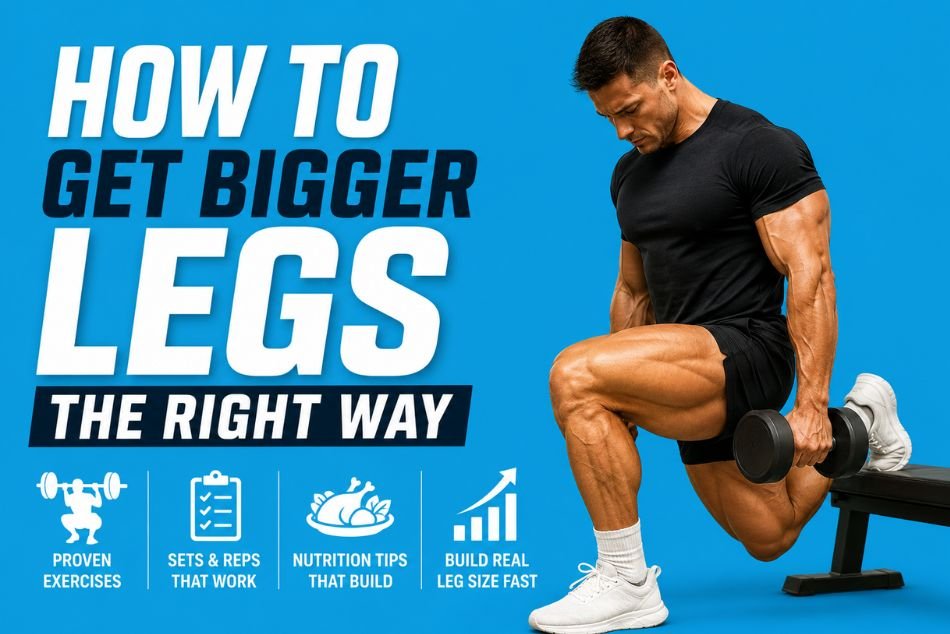
Squats and deadlifts are hard. They ask a lot of your nervous system and your patience. But they’re also the exercises doing most of the heavy lifting, literally, when it comes to adding muscle to your thighs, hamstrings, and glutes.
Genetics Play a Role, but Not the One You Think
Some people build legs faster than others. Limb length, muscle insertion points, and fiber type all matter. But genetics decide how fast you grow, not whether you grow. Even the “hardgainer” builds bigger legs if the training and eating are consistent for long enough.
There’s also the comfort problem. Upper body training happens in front of a mirror, next to the water fountain, in full view of everyone. Squats and leg presses happen tucked in a corner where nobody’s watching, which somehow makes them easier to half-ass. Nobody’s checking your depth on a leg extension the way they’d notice a weak bench press.
The Real Engine Behind Bigger Legs: Progressive Overload
If there’s one concept that explains how to get bigger legs better than anything else, it’s this one. Progressive overload just means your legs need a slightly harder workload over time, whether that’s more weight, more reps, or more total sets.
Muscle has no reason to grow if you lift the same 135 pounds for 3 sets of 10 every single week for a year. Your body adapted to that stimulus months ago.
Get Stronger First, Chase the Pump Second
Chasing a burn or a pump feels productive, and it’s not useless, but it’s not the main driver either. Strength gains on your squat, leg press, and Romanian deadlift are one of the clearest signals that your legs are actually adapting.
Aim to add a small amount of weight or a rep or two every couple of weeks on your main lifts. Five pounds on the bar doesn’t sound like much. Add it up over six months and it is.
Track Your Numbers
Write your workouts down, even if it’s just notes on your phone. You cannot progressively overload something you can’t remember. Most people think they’re adding weight consistently and, when they actually check, they’ve been stuck at the same numbers for two months.
A basic log takes thirty seconds after each set. Exercise, weight, reps, maybe a note on how it felt. Six months later, that scrap of data tells you more about why your legs did or didn’t grow than any amount of guessing.
Warm Up Like You Mean It
Cold legs under a heavy bar is how people get hurt and stay hurt for weeks. Spend five to ten minutes on light cardio, bodyweight squats, and a couple of warm-up sets working up to your first working weight. It’s not exciting, but neither is a strained hamstring that costs you a month of training.
Best Exercises for Bigger Legs
Not every leg exercise pulls its weight. These are the ones worth building your program around.
Back Squat and Front Squat
The back squat is still the single best exercise for overall leg size. It loads the quads, glutes, and hamstrings under a heavy bar and forces your whole lower body to work together. Front squats shift more of the load onto the quads and demand a more upright torso, which makes them a solid second option or a rotation piece.
Romanian Deadlift
If your hamstrings and glutes are lagging behind your quads, the Romanian deadlift fixes that fast. It’s a hip-hinge movement, so keep a slight knee bend and push your hips back rather than squatting the weight down.
Leg Press
The leg press lets you load heavy without worrying about balance or your lower back joining the party. It’s not a replacement for squats, but it’s a great way to add extra volume once your legs are already fried from the main lift.
Walking Lunges
Lunges hit each leg on its own, which exposes and fixes strength imbalances between your left and right side. They’re brutal on the glutes and quads, and they carry over well to real-world movement and athletic performance.
Leg Curls and Leg Extensions
These isolation moves won’t build a leg on their own, but they let you push your hamstrings and quads past the point your compound lifts can safely take them. Add them at the end of a session when the big lifts are already done.
Calf Raises
Calves get ignored constantly, and it shows. Standing and seated calf raises, done for higher reps with a real pause and stretch at the bottom, are what actually grows this stubborn muscle group.
What You Need to Actually Build Bigger Legs
You don’t need a fancy setup for this. A barbell, a squat rack, and enough weight plates to keep progressing covers the core lifts. A leg press or leg curl machine helps but isn’t mandatory in the early stages.
Basic Equipment
A squat rack with safety bars is worth prioritizing over almost anything else in a home gym. Add a barbell, plates, and a pair of good shoes with a flat, stable sole. Lifting belts and knee sleeves help once the weights get heavy, but they’re not needed on day one.
Time Per Session
Budget 45 minutes to an hour for a proper leg session once warm-ups, working sets, and rest periods are all factored in. Heavier compound lifts need longer rest between sets, usually 2 to 3 minutes, so the session naturally runs longer than an arm or shoulder day.
Who Should Follow This Approach
This kind of leg training works for almost anyone, but it fits some situations better than others.
- Beginners Who Skipped Legs for Too Long: If your upper body has years of training behind it and your legs don’t match, starting with the basics above closes that gap faster than any specialized routine would.
- Lifters Who Plateaued on Isolation Work: Spending months on leg extensions and leg curls without touching a barbell squat is a common trap. Adding heavy compound lifts back into the mix usually restarts stalled progress within a few weeks.
- Anyone Training for Athletic Performance: Bigger, stronger legs carry over to running, jumping, and pretty much every field or court sport. The same principles that build size here also build the strength athletes rely on.
How Many Sets and Reps Should You Do for Bigger Legs
Somewhere between 10 and 20 challenging sets per muscle group per week is the range most research points to for building size. That’s not 10 to 20 sets in one workout. Spread it across two or three leg sessions and it stops sounding insane.
Reps in the 6 to 15 range work well for most of your leg exercises. Heavier lifts like squats and Romanian deadlifts sit closer to 5 to 8 reps, while leg press, lunges, and isolation work do fine in the 10 to 15 range.
The last set of every exercise should be genuinely hard. Not to failure every single time, but close enough that you couldn’t casually knock out five more clean reps.
How Often Should You Train Legs
Training your legs twice a week beats hammering them once and limping around for the rest of the week. Splitting your leg volume across two sessions means fresher muscles, better form, and more total quality reps by Sunday.
A Simple Split That Works
One heavier squat-focused day and one day built around hinging, lunging, and higher-rep accessory work covers most of what your legs need. Space them roughly three to four days apart so you’re not walking into session two while still sore from session one.
Don’t Skip Recovery
Muscle grows during recovery, not during the workout itself. Sleep, food, and enough time between sessions matter as much as the sets you actually perform. If your legs are still trashed 72 hours later, that’s a sign to back off the volume slightly, not a badge of honor.
Nutrition for Bigger Legs
Training gives your legs a reason to grow. Food gives them the raw material to actually do it. Skip this part and even a perfect training program stalls out.
- Eat in a Slight Surplus: Building noticeable muscle size is tough in a calorie deficit. A small surplus, somewhere around 200 to 300 calories above maintenance, gives your body enough fuel to grow without piling on excess fat.
- Protein Is Not Optional: Aim for roughly 0.7 to 1 gram of protein per pound of bodyweight daily. Chicken, eggs, fish, beef, Greek yogurt, and a protein shake or two make hitting that number a lot less painful than it sounds on paper.
- Carbs Fuel the Work: Leg day burns through glycogen fast. Rice, oats, potatoes, and fruit refill the tank and help you push harder on your next heavy squat session instead of running on fumes.
- Water and Creatine: Dehydration tanks strength faster than most people realize, and leg sessions are demanding enough without fighting cramps halfway through a squat set. Creatine monohydrate, around 5 grams daily, is one of the few supplements with strong evidence behind it for adding strength and size over time.
Common Mistakes That Kill Leg Growth
People genuinely want how to get bigger legs to happen faster than it does, and that impatience causes most of the mistakes below.
- Skipping Leg Day: The most obvious one, and still the most common. If your upper body sessions never get skipped but leg day mysteriously does, your legs will always lag behind.
- Ego Lifting: Loading the bar heavier than your form can handle turns a squat into a half-rep quarter squat that barely trains the muscle and puts your knees and lower back at risk. Drop the weight, own the full range of motion, and let strength build honestly.
- Not Enough Volume: Three sets of squats and calling it a day might have worked when you were a beginner. Past that stage, your legs need enough total sets across the week to keep adapting.
- Ignoring Hamstrings and Calves: Quad-dominant training builds an imbalanced leg. Hamstrings and calves need direct, dedicated work too, or your legs end up looking unfinished no matter how big your quads get.
- Rushing Rest Between Sets: Cutting rest down to a minute on a heavy squat set means you’re lifting with less strength on every set after the first. Give the big compound lifts 2 to 3 minutes between sets so you can actually push the weight that builds size.
- Chasing Soreness Instead of Progress: Feeling wrecked the next day isn’t proof a workout worked. Some of the best sessions leave you barely sore at all. Weight on the bar and reps in the log matter more than how badly your legs hurt on the walk to your car.
Sample Leg Workout to Build Size
Day 1: Squat Focus
| Exercise | Sets | Reps |
|---|---|---|
| Back Squat | 4 | 6-8 |
| Romanian Deadlift | 3 | 8-10 |
| Walking Lunges | 3 | 10-12 / Leg |
| Leg Extension | 3 | 12-15 |
| Standing Calf Raise | 4 | 12-15 |
Day 2: Hinge and Accessory Focus
| Exercise | Sets | Reps |
|---|---|---|
| Leg Press | 4 | 8-10 |
| Front Squat | 3 | 6-8 |
| Leg Curl | 3 | 10-12 |
| Bulgarian Split Squat | 3 | 10-12 / Leg |
| Seated Calf Raise | 4 | 15-20 |
How Long Does It Take to Get Bigger Legs
Noticeable changes usually show up somewhere between 8 and 12 weeks of consistent training and eating, with visible size differences becoming obvious by the 4 to 6 month mark for most beginners. Intermediate lifters grow slower and need more patience along with smarter programming to keep the progress coming.
Strength usually shows up before size does. Expect your squat and Romanian deadlift numbers to climb steadily in the first couple of months while visible muscle takes a bit longer to catch up. That gap is normal, not a sign anything’s going wrong.
The lifters who get frustrated and quit around week six are usually the ones who were expecting dramatic before-and-after photos on a timeline that muscle simply doesn’t work on. A year of consistent leg training changes how your whole body looks. Six weeks barely scratches the surface, and that’s fine.
Closing Thoughts
Getting bigger legs isn’t complicated, even if it feels that way after a frustrating year of stalled squats. Learning how to get bigger legs really comes down to lifting heavier over time, hitting the right exercises for quads, hamstrings, and calves, training with enough frequency, and eating enough to actually grow. Stick with the basics long enough and consistently enough, and the results show up whether you’re impatient about it or not.
FAQs
Q1) Do Squats Alone Build Bigger Legs?
Squats build most of your leg size, but not all of it. Hamstrings and calves need direct work through Romanian deadlifts, leg curls, and calf raises to develop fully alongside your quads.
Q2) How Many Days a Week Should I Train Legs for Growth?
Two dedicated leg sessions per week, spaced a few days apart, works well for most lifters chasing size. It spreads your weekly volume out so you’re training with fresher muscles and better form.
Q3) Can You Get Bigger Legs Without Weights?
Bodyweight training can build noticeable leg size for beginners, especially with pistol squats, jump squats, and high-rep lunges. Past the early stages, added resistance becomes necessary to keep challenging the muscle.
Q4) Why Are My Legs Not Growing Even Though I Train Them?
Usually it comes down to one of three things: not enough total volume, not eating enough to support growth, or the same weights being used week after week without progression. Track your lifts and your food for a few weeks and the gap usually becomes obvious.
Q5) Is It Normal for Legs to Grow Slower Than Other Muscles?
Yes. Leg muscles are large and used constantly just walking around, so they often need more total volume and more patience to show visible growth compared to smaller muscle groups like arms.