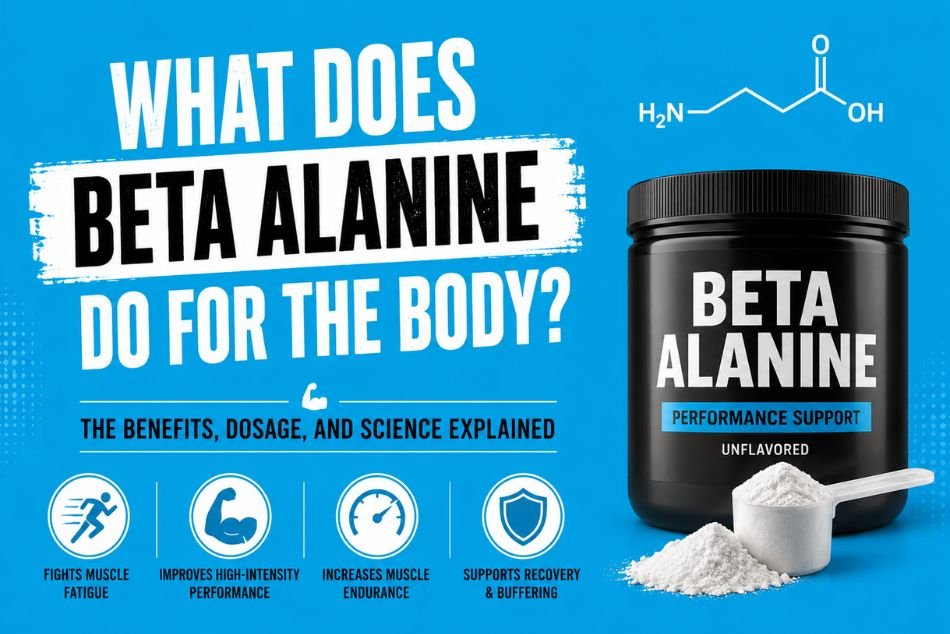
What Does Beta Alanine Do for the Body? Here’s the Answer Before You Buy a Tub
If you’ve ever stood in the supplement aisle wondering what does beta alanine do for the body, you’re not alone. It shows up in nearly every pre-workout powder on the shelf, yet most labels never explain what it’s actually doing once it hits your bloodstream. This guide breaks it down in plain language, no biochemistry degree required.
By the end, you’ll know exactly why your face tingles ten minutes after a scoop, how much to take, and whether it’s worth adding to your routine at all.
What Is Beta Alanine, Exactly?
Beta alanine is a non-essential amino acid. Your liver makes some of it on its own, and you also get it from meat, poultry, and fish.
The problem is that the amount your body produces and the amount in a normal diet fall well short of what research uses to see results. That’s why it shows up as a standalone supplement instead of something you just eat more chicken to fix.
It’s also worth clearing up a common mix-up. Beta alanine is not the same thing as alanine, the more common amino acid used to build proteins throughout your body. Beta alanine has a slightly different molecular structure, and its main job in the body is acting as the raw material for carnosine rather than getting built into muscle tissue itself.
A Bit of Background on Why It Became a Pre-workout Staple
Beta alanine wasn’t always a gym-bag regular. For years it sat mostly in academic sports science journals, studied alongside rowers, sprinters, and combat athletes rather than sold in flavored tubs.
That changed once companies started marketing branded, sustained-release versions directly to lifters. The underlying science didn’t really shift, it just got packaged and sold a lot more aggressively than it used to be.
How It Turns Into Carnosine
Beta alanine doesn’t do much on its own. Once inside the body, it pairs up with another amino acid called histidine to form a compound called carnosine.
Carnosine sits inside your muscle fibers, particularly the fast-twitch ones you rely on for sprinting, heavy lifting, and anything else that burns hard and fast. Histidine is usually already sitting around in plenty inside your muscles. Beta alanine is the piece that’s missing, which is why supplementing with it, rather than histidine, is what actually raises carnosine levels.
What Does Beta Alanine Do for the Body During Exercise?
Here’s where it gets useful. When you push through a hard set or a sprint, your muscles produce hydrogen ions as a byproduct of breaking down glucose for energy.
Those hydrogen ions build up and drop the pH inside your muscle. Once the environment gets too acidic, your muscles simply stop contracting as efficiently. That burning, seizing feeling on rep eight of a squat set is largely this process playing out.
Carnosine acts as a buffer. It mops up some of those hydrogen ions before they can drag your muscle pH down too far. More carnosine in the muscle means a bit more room to keep pushing before the burn forces you to rack the bar or slow down.
The International Society of Sports Nutrition has reviewed this extensively, and their position is fairly clear: four weeks of beta alanine at 4 to 6 grams daily reliably increases muscle carnosine and can meaningfully improve performance in efforts lasting roughly one to four minutes. Think 400m repeats, a tough set of 12 to 20 reps, or a hard round of intervals.
Who Actually Benefits Most From Beta Alanine
Not every athlete gets the same payoff. Beta alanine’s biggest wins show up in activities that hover in that one to four minute window of near-maximal effort, where acid buildup is the main thing shutting you down.
That covers a wide range of people: 400m and 800m runners, rowers, wrestlers and other combat athletes doing repeated hard rounds, soccer or basketball players stringing together sprints, and lifters doing higher-rep sets in the 12 to 20 range.
If your training leans heavily toward long, steady endurance work, or toward pure one-rep-max strength attempts that last a few seconds, the benefit shrinks. Beta alanine isn’t doing much for you on a single heavy deadlift attempt, and it’s not the main lever for a three-hour bike ride either. It lives in that middle zone of sustained, brutal effort.
Beyond Muscle Buffering
Carnosine does more than just soak up acid. Research also points to a few other roles worth knowing about, even if the effects on daily training are smaller than the buffering benefit.
- Antioxidant activity. Carnosine helps mop up some of the oxidative stress that builds up during intense training.
- Calcium handling. It appears to help shuttle calcium back into the part of the muscle cell responsible for contraction, which may support how efficiently your muscles fire.
- Tissue presence beyond muscle. Carnosine is also found in the brain and heart, though the research on beta alanine’s effect in those tissues is much thinner than what exists for skeletal muscle.
None of this means beta alanine is some miracle longevity compound. The honest answer is that the muscle-buffering effect is the one backed by the most solid research, and everything else is a secondary bonus at best.
So What Does Beta Alanine Do for Your Actual Training?
Strip away the biochemistry and here’s the practical version: beta alanine buys you a few extra reps or a few extra seconds before fatigue catches up.
It won’t turn a bad program into a good one. It won’t build muscle by itself. What it does is let you squeeze slightly more volume and intensity out of the sessions you’re already doing, which over months can add up to real progress.
How Much Beta Alanine Should You Take?
Most of the research supporting real results uses 4 to 6 grams per day, and the effect builds over time rather than kicking in during a single session. Unlike caffeine, you won’t feel a noticeable performance boost the first time you take it.
Consistency matters more than timing. Taking it daily, whether or not you’re training that day, is what raises your baseline carnosine levels. Studies generally run at least four weeks before measuring a real change, and some go longer.
Splitting Your Doses to Dodge the Tingles
Take a full 5-gram dose all at once and you’ll likely feel a strong tingling sensation, sometimes uncomfortable enough to be distracting. Splitting your daily total into smaller doses of around 1.5 to 2 grams, spaced a few hours apart, cuts down on that sensation without losing the benefit.
Some products use a sustained-release formula specifically to smooth this out. If tingling bothers you, that’s worth looking for on the label.
The Tingling Sensation – Should You Worry About It?
This is called paresthesia, and it’s the most talked-about side effect of beta alanine. It happens because beta alanine activates a receptor on nerve endings just under the skin, usually felt on the face, neck, and back of the hands.
It’s harmless. Research hasn’t linked it to any lasting nerve damage, and it typically fades within an hour. If you notice actual swelling, hives, or trouble breathing, that’s a different situation and worth taking seriously, but a bit of skin-crawling itchiness on its own isn’t a red flag.
Worth mentioning: a stronger tingle doesn’t mean the supplement is working better. It’s just a sign you took a bigger single dose, not proof of extra carnosine being built.
Beta Alanine vs Other Pre-workout Ingredients
Walk down the supplement aisle and beta alanine is usually sitting next to caffeine, citrulline malate, and creatine on the same label. They’re not interchangeable, even though marketing sometimes blurs the lines.
Caffeine works fast, hitting your central nervous system within 30 to 60 minutes and giving you that immediate jolt of focus and drive. Beta alanine does nothing that quickly. Its entire value comes from weeks of steady use raising carnosine in the background.
Citrulline malate is aimed at blood flow and the pump, working through a completely different pathway than acid buffering. Creatine, as mentioned earlier, supports quick energy production for short, explosive efforts rather than buffering fatigue.
None of this makes beta alanine less useful. It just means it’s solving a different problem than the ingredients sitting next to it on the label, and it’s worth knowing which one is actually responsible for which feeling during your workout.
Food Sources vs Supplements
Meat, poultry, and fish all contain some beta alanine naturally, since it’s part of carnosine found in animal tissue. That’s part of why some vegetarians and vegans test lower on carnosine levels than meat eaters.
Getting to the 4 to 6 gram range through food alone is basically impossible without eating an unreasonable amount of meat every single day. That’s the practical reason supplements exist for this one.
Powder, Capsules, or Pre-workout Blends?
Beta alanine comes in a few forms, and none of them changes how it works once it’s in your system. Straight powder is cheap and lets you control the dose precisely, though the flavor is bland at best.
Capsules skip the taste problem but make it harder to split doses through the day, since you’re stuck with whatever gram amount is packed into each pill. Pre-workout blends bundle it with caffeine and other ingredients, which is convenient but means you’re locked into whatever ratio the manufacturer chose rather than dialing in your own numbers.
If you’re just starting out, plain powder is the easiest way to figure out your own tolerance for the tingling before committing to a bigger tub or a blend you can’t easily adjust.
Stacking It With Creatine and Sodium Bicarbonate
Beta alanine is often paired with creatine, and there’s reasonable evidence the two can work well together since they act through different pathways, one supporting quick energy production and the other supporting acid buffering.
Sodium bicarbonate, plain baking soda in supplement form, works on a similar buffering principle but from outside the muscle cell rather than inside it. Some athletes combine the two, though the research on stacking is less developed than the research on beta alanine alone.
Does Age Change Anything?
Most of the marketing around beta alanine targets younger, competitive lifters, but some research has actually looked at older adults too. Muscle carnosine tends to decline with age, right around the same years that muscle strength and function start slipping.
A handful of studies in older populations found that beta alanine supplementation raised carnosine levels similarly to what’s seen in younger adults, with some improvements in muscle function and general exercise tolerance. It’s not a fountain of youth, and the research pool is smaller than what exists for younger athletes, but it’s a reasonable option for an older adult trying to hang onto strength and stamina, not just a young sprinter’s supplement.
Who Should Be a Bit More Careful
Beta alanine is generally considered safe for healthy adults at the doses studied. That said, there isn’t much reliable safety data for pregnant or breastfeeding women, so it’s better to skip it or check with a doctor first in that situation.
If you’re on any medication or managing a kidney condition, it’s worth a quick conversation with your doctor before adding any new supplement, not because beta alanine has a bad safety record, but because that’s just sound practice with anything you’re taking daily for months.
Competitive athletes can relax on one front: beta alanine isn’t on the World Anti-Doping Agency’s prohibited list.
Common Mistakes People Make With Beta Alanine
- Expecting instant results. This isn’t caffeine. A single scoop before today’s workout won’t do much. It’s a slow build over weeks.
- Taking one huge dose instead of splitting it. This mostly just buys you more tingling, not more benefit.
- Quitting after a week. Most people give up right when carnosine levels are only starting to climb. Four weeks is closer to the real test.
- Assuming it replaces a real program. No supplement fixes a lazy training plan. Beta alanine supports effort you’re already putting in; it doesn’t manufacture effort out of nothing.
Tips to Get the Most Out of It
- Stick to 4 to 6 grams daily, split into 2 to 3 smaller doses.
- Take it with food if the tingling bothers you.
- Give it a full month before judging whether it’s working.
- Pair it with training that actually involves repeated hard efforts in the 1 to 4 minute range, since that’s where the research shows the clearest benefit.
- Don’t stress if the tingling is mild or barely noticeable one day. It doesn’t reflect how much carnosine you’re building.
Wrapping Up
So, what does beta alanine do for the body? In short, it raises carnosine in your muscles, which helps buffer the acid buildup that causes fatigue during hard, short bursts of effort.
It’s not flashy, and it won’t do the work for you. But for anyone doing repeated sprints, hard sets, or short high-intensity intervals, a consistent 4 to 6 grams a day, taken for at least a month, is one of the more well-supported ways to squeeze a bit more out of the training you’re already doing.
FAQs
Q1) Does Beta Alanine Build Muscle on Its Own?
Not directly. It helps you push a little further in a set, which over time can support more training volume, but it isn’t a muscle-building compound by itself.
Q2) How Long Before You Notice a Difference?
Most research points to somewhere around four weeks of daily use before muscle carnosine rises enough to matter. Some people report a subtle difference in how many reps they can grind out sooner, but the real shift takes time.
Q3) Is the Tingling a Sign of an Allergic Reaction?
No, in the vast majority of cases. Paresthesia is a known, harmless nerve response. An actual allergic reaction would come with swelling, hives, or breathing trouble, which is a completely different picture.
Q4) Should You Take It On Rest Days Too?
Yes. Since the goal is raising your baseline carnosine level over weeks, daily use, training day or not, is what the research is actually built around.
Q5) Does Beta Alanine Work for Endurance Runners or Cyclists?
To some degree, but it’s not where the strongest evidence sits. The clearest benefits show up in efforts lasting one to four minutes, so a marathon or a long steady ride won’t get nearly as much out of it as a set of hill sprints or repeated rowing intervals would.
Q6) Can You Take Too Much Beta Alanine?
Very high single doses mostly just cause more intense tingling rather than added benefit. Sticking to the studied range of around 4 to 6 grams a day, split up, gets you the results without the discomfort of pushing past what your body needs.