A Simple Breakdown of How to Structure a Workout That Actually Works
Walk into any gym and you’ll see two kinds of people. One group moves from machine to machine with no real plan, doing whatever looks free at the moment. The other group has a rhythm to their session: warm-up, main lifts, accessory work, done. That second group isn’t necessarily working harder. They just know how to structure a workout, and that single skill changes almost everything about the results you get from your time in the gym.
Most people don’t fail at the gym because they lack effort. They fail because their sessions are random. Grabbing whatever machine is open, doing a few sets, then moving to something else isn’t a plan. It’s just movement. And movement without order doesn’t build strength nearly as fast as training that follows a logical sequence.
The good news is that workout structure isn’t complicated once you understand the pieces. It comes down to five things: how you warm up, what order you do exercises in, how many sets and reps you perform, how long you rest, and how you finish the session.
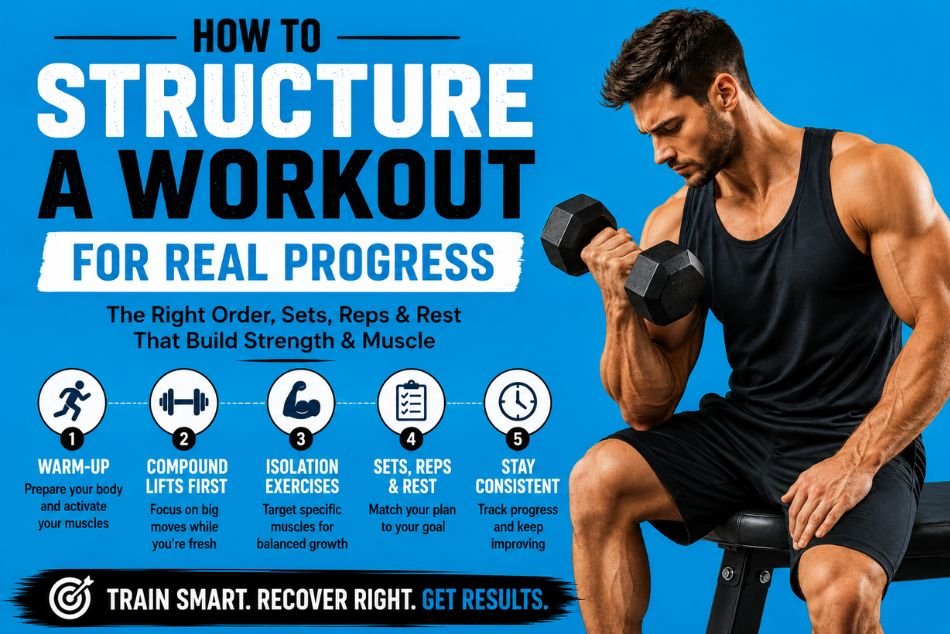
Why Workout Structure Matters More Than You Think
Here’s the thing nobody tells beginners: the order you do exercises in changes how much you actually get out of them.
Your nervous system is sharpest and your muscles are freshest at the start of a workout. That’s when you should be doing the exercises that demand the most from you: the heavy compound lifts that build the bulk of your strength. Save the small stuff for later, when a little fatigue won’t wreck your form.
A study on untrained lifters found something worth remembering. Exercises placed at the end of a session consistently failed to produce meaningful strength gains, no matter which muscles they targeted. Order isn’t a minor detail. It decides which parts of your training actually pay off.
Step One: Warming Up the Right Way
Skipping the warm-up is one of the most common mistakes lifters make, and it’s also one of the easiest to fix.
A solid warm-up does two things. First, it raises your heart rate and gets blood moving into the muscles you’re about to train. Second, it primes your joints and nervous system for the specific movements ahead, which lowers your injury risk and makes your working sets feel more controlled.
Five to ten minutes of light cardio is a good starting point. Rowing, cycling, or just brisk walking works fine. From there, move into dynamic stretches and movement-specific ramp-up sets. If your first lift is a heavy squat, don’t jump straight to your working weight. Work up through a few lighter sets first so your body knows what’s coming.
If you’re planning a longer session, closer to 60 minutes, give yourself 10 to 15 minutes to warm up properly. Rushing this part to save time usually costs you more time later in recovery.
Step Two: Get the Exercise Order Right
This is where knowing how to structure a workout really pays off. Once you’re warmed up, the order you tackle your exercises in should follow a few simple rules.
Compound Movements Come First
Squats, deadlifts, bench presses, overhead presses, and rows all recruit large amounts of muscle mass at once. They also let you move the most weight, which is exactly why they belong at the front of your session while you’re still fresh.
Doing isolation work like curls or lateral raises before your compound lifts pre-fatigues smaller muscles that your big lifts depend on. Train biceps before you bench, and don’t be surprised when your pressing strength takes a hit.
Isolation Work Comes After
Once the heavy compound lifts are done, that’s your window for isolation exercises: bicep curls, triceps pushdowns, lateral raises, calf raises. These target specific muscles that compound lifts might not fully develop, and doing them with a bit of accumulated fatigue isn’t a problem the way it would be for your main lifts.
Big Muscles Before Small Ones
A similar logic applies across your whole session. Train larger muscle groups (back, chest, legs) before smaller ones like shoulders, arms, or calves. This keeps your energy focused where it has the biggest payoff.
Step Three: Sets, Reps, and Rest Matched to Your Goal
Not every rep range does the same job, and this is where a lot of people get their structure wrong. Different goals call for different set and rep schemes.
For Strength: Work in the 3 to 6 rep range with heavier loads, generally stopping a couple of reps short of failure. This builds raw force without burying you in fatigue.
For Muscle Growth: The 6 to 12 rep range is the most well-supported window for hypertrophy. Most people building muscle should spend the bulk of their training here.
For Muscular Endurance: Sets of 12 to 20-plus reps with lighter loads fill this gap, useful for conditioning-focused goals.
Rest periods matter just as much as the reps themselves.
| Training Goal | Rest Between Sets |
|---|---|
| Heavy strength / compound lifts | 2 to 5 Minutes |
| Hypertrophy (muscle growth) | 60 to 120 Seconds |
| Muscular endurance | 30 to 60 Seconds |
Cutting your rest short to save time can feel productive, but under-recovering between heavy sets means you lift less weight on your next set. That adds up over a training cycle. A well-known comparison of one-minute versus three-minute rest intervals in experienced lifters found the longer rest produced better results for both strength and muscle size.
How Long Should a Session Actually Be?
Most effective workouts run somewhere between 30 and 60 minutes, warm-up and cool-down included. Go much longer than that and quality tends to drop off. Your focus fades, and so does the intensity you’re bringing to each set.
If strength is your main priority, plan your session so your compound lifts happen while you’re still fresh, even if that means trimming your accessory work. If your priority leans toward endurance or general conditioning, it’s fine to flip the order occasionally and start with cardio instead.
Where Cardio Fits Into the Structure
Cardio has a place in almost every well-structured program, but where you put it matters.
If your main goal is strength or muscle, save cardio for the end of your session or do it on a separate day entirely. Doing hard cardio before lifting will eat into the energy your compound lifts need. Save the gas tank for the barbell first.
If conditioning is your primary focus, it’s reasonable to front-load cardio and treat resistance training as the secondary piece of the session.
Don’t Skip the Cool Down
The last few minutes of a workout are easy to blow off once the hard work is done, but they matter more than people give them credit for.
A short cool down (a few minutes of light movement followed by static stretching) helps your heart rate come back down gradually and starts the recovery process. It’s a small addition to your session, but skipping it consistently adds up over weeks of training.
Full Body vs. Split Routines: How Structure Changes
The way you structure a workout also depends on how you’re dividing your training week. Two lifters with identical goals can end up with very different session layouts depending on whether they’re training full body or running a split.
Full Body Training
A full body session hits most major muscle groups in one workout, usually a squat pattern, a hinge pattern, a push, and a pull. This works well for beginners or anyone training two to three days a week, since each muscle group gets trained multiple times weekly without needing extra sessions.
The structure inside a full body day stays the same as everything covered above: warm up, biggest compound lift first, then work down through the remaining patterns in order of demand.
Split Routines
A split spreads training across specific days: upper/lower, push/pull/legs, or body-part splits like chest day and back day. These suit lifters training four or more days a week who want more volume per muscle group in a single session.
The internal structure of each day doesn’t change. You still open with the heaviest compound movement for that day’s focus and work toward isolation work as the session progresses. What changes is how much volume you can dedicate to each muscle group, since you’re not trying to cover the whole body in one sitting.
Neither approach is objectively better. The right one depends on how many days you can realistically train and how much recovery time you have between sessions.
Adjusting Structure for Your Experience Level
How to structure a workout isn’t identical for a first-timer and someone who’s been training for five years. Experience changes a few of the details.
Beginners benefit from simpler sessions: fewer exercises, straightforward rep schemes, and more focus on learning proper form on the big compound lifts before adding complexity. Three full body sessions a week with two to three main lifts per day is plenty to start building a foundation.
Intermediate lifters can usually handle more volume and benefit from a split routine, since their recovery capacity has improved and they’re no longer making rapid beginner-level progress on a simple structure alone.
Advanced lifters often need more deliberate variation: rotating rep ranges, adjusting intensity across a training block, and sometimes prioritizing specific lagging muscle groups within their weekly structure. At this stage, structure becomes less about the basics and more about fine-tuning based on what your body responds to.
Regardless of experience level, the underlying rules don’t change. Warm up, train compound movements first, match sets and reps to your goal, and rest according to what you’re training for.
Sample Workout Structures
Seeing the pieces laid out in a real session makes the whole idea click faster. Here’s what a well-structured strength session looks like on paper.
Lower Body Strength Day
| Segment | Exercise | Sets x Reps |
|---|---|---|
| Warm-Up | Light cardio + dynamic stretching | 5-10 Min |
| Compound (Primary) | Back Squat | 4 x 5 |
| Compound (Secondary) | Romanian Deadlift | 3 x 8 |
| Accessory | Bulgarian Split Squat | 3 x 10 |
| Isolation | Leg Curl | 3 x 12 |
| Core | Plank / Dead Bug | 3 x 30-45 Sec |
| Cool Down | Static stretching | 5 Min |
Upper Body Hypertrophy Day
| Segment | Exercise | Sets x Reps |
|---|---|---|
| Warm-Up | Band pull-aparts + light pressing | 5-10 Min |
| Compound (Primary) | Incline Bench Press | 4 x 8 |
| Compound (Secondary) | Seated Row | 3 x 10 |
| Accessory | Overhead Press | 3 x 10 |
| Isolation | Lateral Raise + Bicep Curl (superset) | 3 x 12 |
| Isolation | Triceps Pushdown | 3 x 12 |
| Cool Down | Static stretching | 5 Min |
Notice the pattern in both. Warm-up first, heaviest and most demanding lift second, smaller accessory and isolation work after, cool down last. That’s the entire framework behind how to structure a workout for almost any goal.
Common Mistakes People Make With Workout Structure
Even experienced lifters fall into a few of these traps.
- Skipping the warm-up to save time. This is the fastest way to walk into a heavy lift underprepared, and it raises your injury risk for no good reason.
- Doing isolation work first. Curling before you bench, or doing leg extensions before squats, pre-fatigues the exact muscles your compound lifts need most.
- Cutting rest periods too short. Rushing between heavy sets means every set after the first is weaker than it should be.
- Changing the plan mid-session. Randomly swapping exercises because something “looks fun” undoes the logic behind the order you built in the first place.
- Ignoring the cool down entirely. It’s a small piece of the session, but it’s part of the structure too, not an optional extra.
Tips to Keep Your Workout Structure Working Long-Term
A good structure isn’t something you set once and forget. A few habits keep it working over months, not just weeks.
Track your numbers. Write down your sets, reps, and weights so you can see whether you’re actually progressing week to week.
Rotate your exercise order every four to six weeks. Keep the underlying principles (compounds before isolation, big muscles before small) but swap which lift goes first occasionally to avoid staleness and keep every muscle group getting fresh attention.
Adjust rest periods based on how you feel that day, not just what’s written on paper. Some sessions call for a little extra recovery time, and that’s fine.
Don’t chase soreness. A workout doesn’t need to leave you wrecked to be effective. Consistent, well-structured sessions beat occasional brutal ones by a wide margin over time.
Planning Around Equipment and Time Constraints
Not everyone has access to a fully loaded gym, and that’s fine. The structure still applies. It just needs to flex around what you’ve got.
If you’re training at home with limited equipment, prioritize the compound movements you can actually load heavy: goblet squats, dumbbell presses, rows, and hip hinges. Skip the isolation work if time is tight rather than cutting corners on your main lifts. A shorter session that keeps the right order beats a longer one that loses the plan halfway through.
If you’re short on time generally, a good fallback is one compound push, one compound pull, and one leg movement, followed by a single accessory exercise if there’s time left. That’s a stripped-down version of the same structure, and it still delivers most of the benefit of a full session.
Busy weeks happen. The goal isn’t to nail a perfect session every single time. It’s to keep the same underlying order intact even when the workout itself gets shorter.
Wrapping Up
Knowing how to structure a workout isn’t about following a rigid formula that never changes. It’s about understanding why certain things go first, why rest periods matter, and why a five-minute cool down is worth the time you think you don’t have.
Warm up properly, hit your compound lifts while you’re fresh, match your sets and reps to your actual goal, and don’t skip the parts at the end that feel optional. Do that consistently, and the structure starts doing a lot of the work for you.
FAQs
Q1) How Long Should a Workout Session Last?
Most effective sessions run between 30 and 60 minutes, including warm-up and cool-down. Longer sessions tend to lose intensity and focus toward the end.
Q2) What’s the Correct Exercise Order in a Workout?
Warm up first, then move into compound movements while you’re fresh, followed by isolation exercises, and finish with cardio or a cool down depending on your main goal.
Q3) How Much Rest Should I Take Between Sets?
Heavy compound lifts need 2 to 5 minutes of rest. Hypertrophy work is best with 60 to 120 seconds. Endurance-focused sets only need 30 to 60 seconds.
Q4) Should Cardio Come Before or After Lifting?
If strength or muscle is your priority, do cardio after lifting or on a separate day. If conditioning is your main goal, it’s fine to do cardio first.
Q5) How Often Should I Change My Workout Structure?
Rotate specific exercises every four to six weeks, but keep the core principles the same: compounds before isolation, big muscle groups before small ones.