How to Train Like an Athlete (and Why Most People Never Do)
Most people go to the gym with no real plan. They cycle through the same exercises, add weight whenever they feel like it, and wonder why they stop making progress after a few months. If you actually want to know how to train like an athlete, the answer isn’t complicated — but it does require you to stop winging it.
Athletes don’t train randomly. They follow structured programs built around a few proven principles: progressive overload, compound movements, periodization, and deliberate recovery. Those principles are the same whether you’re a Division I sprinter or a 35-year-old trying to get strong and stay healthy.
This guide breaks down what athlete training actually looks like — the principles behind it, what a typical week might look like, and how you can apply it starting this week. No gimmicks. No fancy equipment required.
Start With the Big Lifts — Everything Else Is Secondary
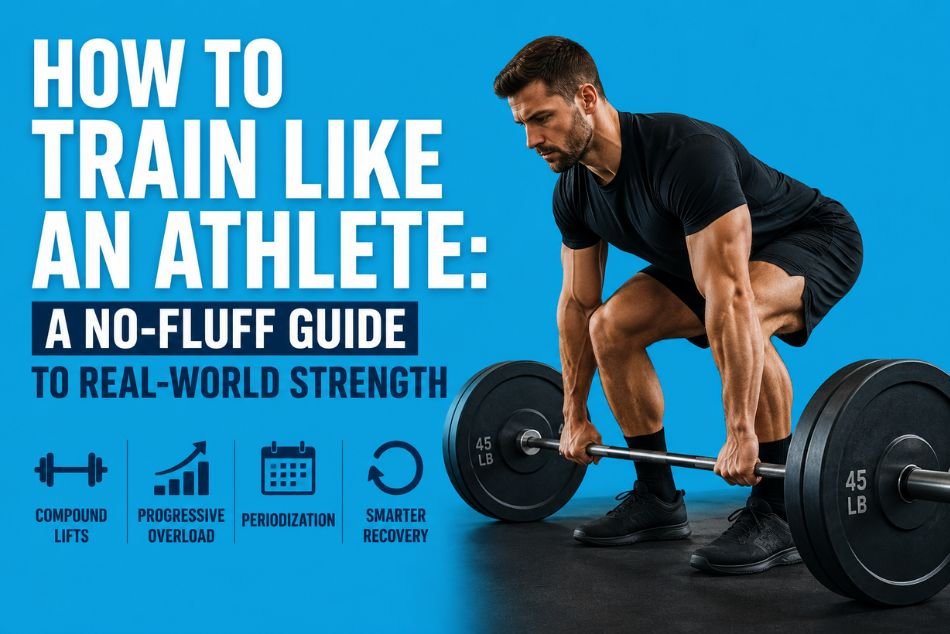
Athletes build their training around compound movements — exercises that work multiple muscle groups at once and put serious load on the body. The squat, deadlift, bench press, and overhead press are the foundation.
There’s a reason these four lifts show up in almost every serious program. They’re hard. They require full-body coordination. And they produce results that isolation exercises simply can’t match.
If you’re spending most of your gym time on cable flies and tricep kickbacks, you’re leaving serious strength gains on the table. Those exercises aren’t useless — but they come after the main work, not instead of it.
A practical rule: every workout should have one primary compound lift. Build the session around that. Assistance work comes after, and it should support the main lift — not compete with it.
Progressive Overload: The Principle That Actually Makes You Stronger
The single most important concept in strength training is progressive overload. Your body adapts to the stress you put on it. If you never increase that stress, you stop adapting. It’s that simple.
Progressive overload doesn’t always mean adding weight to the bar. You can also progress by doing more reps with the same weight, reducing rest time, improving technique, or increasing training frequency.
The mistake most gym-goers make is trying to jump weight too fast. They add 20 pounds because they felt strong last session, stall out within two weeks, and then reset. Athletes understand that slow, consistent progress beats chasing big numbers.
Jim Wendler’s 5/3/1 — a program we’ve covered in detail over at spcfitz.com — is one of the best examples of disciplined progressive overload. You add small amounts of weight each month, work within rep ranges that match your current training max, and never ego-lift. That approach compounds over time in a way that random heavy days never will.
Periodization: Train in Phases, Not Just Sessions
Professional athletes don’t train the same way year-round. Their programs are periodized — broken into phases with different goals. Off-season work looks nothing like in-season maintenance.
For most people who aren’t competing, periodization still matters. You can’t push at maximum intensity every week without breaking down. The body needs phases of higher volume, phases of higher intensity, and phases of deliberate backing off.
A basic model looks something like this: spend a few weeks building volume at moderate weight, then shift to heavier weights with less volume, then take a deload week where you reduce intensity and let the body catch up. Repeat.
Most people skip deloads because they feel like a step backward. They’re not. Deloads are where adaptation actually happens. Ignoring them is one of the fastest ways to hit a plateau or get injured.
What a Real Athletic Training Week Looks Like
If you want to know how to train like an athlete in practical terms, here’s what a solid 4-day week might look like for a non-competitive lifter focused on building strength and conditioning.
Monday: Lower body focus. Squat as the main lift. Two or three assistance exercises — Romanian deadlifts, leg press, or walking lunges. Keep it under an hour.
Tuesday: Upper body push. Bench press or overhead press as the main lift. Assistance work for shoulders, triceps, and upper back. Done.
Thursday: Posterior chain and pulling. Deadlift or Romanian deadlift as the main lift. Pull-ups, barbell rows, face pulls. The back is underdeveloped in most people — this day fixes that.
Saturday: Conditioning or a second upper body session. This is where you can mix in carries, sled work, circuits, or whatever conditioning you need for your goals.
Wednesday, Friday, and Sunday are rest or active recovery. That means walking, light mobility work, or just getting outside. Not another brutal gym session.
Conditioning Isn’t Optional — Even for Strength Athletes
A common mistake in the lifting community is treating cardio and conditioning as enemies of strength. They’re not. Athletes need both.
Conditioning builds work capacity — your ability to sustain effort and recover between sets. A stronger aerobic base means you recover faster, both within workouts and between training sessions. That translates directly into better performance on the big lifts.
You don’t need to run marathons. Two or three sessions of low-intensity conditioning per week — 20 to 30 minutes of brisk walking, cycling, or rowing — is enough for most people. High-intensity intervals once a week can also be added if your recovery handles it.
The US Olympic and Paralympic Committee notes that a proper strength and conditioning program looks at the physical demands of the sport and the individual needs of the athlete. For recreational lifters, those needs usually include some cardiovascular base, not just max strength.
Technique Before Ego: One Thing Athletes Get Right
Here’s something you notice right away when you watch serious athletes train: they’re not maxing out every session. They move well. They use weights that challenge them without breaking their form.
Ego lifting — adding weight before you’ve earned it — is one of the most common reasons recreational lifters plateau or get hurt. A squat with a rounded lower back isn’t training the squat. It’s training a compensation pattern that will eventually cause problems.
The rule is simple: if you can’t do it with good form, the weight is too heavy. Drop it. Build the pattern. Add weight slowly. This isn’t the exciting answer, but it’s the correct one.
If you’re unsure about technique, get one or two sessions with a qualified coach. It’ll save you months of guessing and potentially years of dealing with an injury that could have been avoided.
Recovery Is Training — Treat It That Way
Most recreational lifters have recovery completely backwards. They think more sessions equals more results. Athletes know better.
You don’t get stronger in the gym. You get stronger when you sleep, when you eat, and when you give your body time to rebuild from what you put it through. Training is the stimulus. Recovery is where adaptation happens.
Sleep is non-negotiable. Seven to nine hours for most adults. Not six hours and two coffees. Not catching up on weekends. Consistent, quality sleep is the single highest-return recovery tool available — and it’s free.
Nutrition matters too. You can’t train hard on empty calories. Adequate protein — typically 0.7 to 1 gram per pound of bodyweight for active lifters — is the minimum. Getting enough total calories to support training volume is just as important.
Active recovery — light movement on rest days — keeps blood flowing to muscles and reduces soreness without adding fatigue. A 20-minute walk does more for next-day performance than lying on the couch watching television.
Mindset: How to Train Like an Athlete When You Don’t Feel Like One
The mental side of training is underrated. Athletes show up when they’re tired. They do the boring work. They follow the program on the days it doesn’t feel exciting.
Jim Wendler’s philosophy is built around exactly this. His program isn’t flashy. It’s deliberate, incremental, and unglamorous — and that’s the point. Showing up consistently with a sound plan beats sporadic intensity every single time.
One principle worth adopting: track your training. Write down what you lifted, how many reps, how you felt. Athletes have training logs. Most recreational lifters don’t. The log keeps you honest and shows you the progress you’d otherwise forget.
Another one: stop changing programs every three weeks. Consistency with an average program beats switching between great programs. Give a program at least eight to twelve weeks before judging whether it’s working.
Common Mistakes That Kill Progress
A few patterns show up repeatedly in people who train hard but never seem to get better.
Skipping the warm-up. Athletes spend real time preparing the body to move. Five minutes on a treadmill followed by jumping straight into heavy sets isn’t a warm-up. Mobility work, activation exercises, and progressive warm-up sets matter.
Training with too much volume. More is not always better. Fourteen exercises per session with six sets each isn’t training — it’s junk volume. The body can only recover from so much. Keep it focused.
Neglecting the posterior chain. The muscles on the back of the body — hamstrings, glutes, upper back, rear delts — are underdeveloped in most people who train. This creates imbalances that lead to both poor performance and injuries. Pull as much as you push.
Chasing soreness as a metric for a good workout. Soreness means you did something your body wasn’t used to. That’s all. It’s not a reliable indicator of progress or effort.
Where to Start if You’re Building From Scratch
If you’re newer to structured training, the worst thing you can do is jump into an advanced program. Start with something that matches your current level and has room to grow.
A beginner can gain strength fast on almost any consistent program with compound lifts and progressive overload built in. Learn the squat, deadlift, press, and row. Move well. Add weight when you can.
Once you’ve got six months of consistent training under your belt and your technique is solid, you’re ready for an intermediate program. That’s when something like 5/3/1 — which we break down step by step at spcfitz.com — starts making real sense.
For complete beginners, three days a week of full-body work is enough. You don’t need six days and two-hour sessions. You need to build the habit and the movement patterns. Consistency in year one will outperform any advanced programming.
The Role of Assistance Work
Every serious athlete does work outside their main sport or primary lifts. For strength athletes, that means assistance exercises — movements that support the main lifts without replacing them.
The point of assistance work is to address weaknesses. If your bench press stalls because your triceps give out at the top, close-grip bench and tricep pushdowns are relevant. If your squat breaks down because of hip weakness, single-leg work and hip strengthening belong in the program.
The rule with assistance work: it should have a reason. Random exercises just to feel busy is wasted energy. Pick two or three assistance exercises per session with a clear purpose.
Also important: don’t let assistance work trash your recovery. If you do 20 sets of leg press after squatting, you’re not helping your squat — you’re just making it harder to walk the next day.
Final Thoughts on How to Train Like an Athlete
Learning how to train like an athlete doesn’t require a professional sports contract, a Division I facility, or a personal strength coach. It requires a few things most people overlook: a structured plan, compound lifts, progressive overload, and real recovery.
The athletes who stay healthy and keep improving over years aren’t the ones who train the hardest every single day. They’re the ones who train smart, follow a program, and know when to back off.
If you want a proven starting point, check out the programs and guides at spcfitz.com. The 5/3/1 breakdown there is a good example of what principled programming looks like in practice — simple to follow, built to last, and designed for real-world lifters.
Pick a program. Learn to move well. Add weight slowly. Recover on purpose. That’s not a complicated formula — but it’s the one that works.
Frequently Asked Questions
Q1) Do I Need to Be an Actual Athlete to Train Like One?
Not at all. The principles behind athletic training — compound lifts, progressive overload, periodization, real recovery — apply to anyone. You don’t need a sport, a coach, or a professional contract. What you need is a structured plan and the discipline to follow it consistently. Most people who learn how to train like an athlete are recreational lifters who just got tired of spinning their wheels with no real system.
Q2) How Many Days a Week Should I Train?
For most people, three to four days a week of structured training is the sweet spot. That’s enough to drive meaningful progress while leaving room for recovery. Professional athletes often train more frequently, but that’s their full-time job with full-time support staff around them. For the average person juggling work and life, four focused sessions per week beats six mediocre ones every time. The programs we cover at spcfitz.com — including the 5/3/1 breakdown — are all built around this kind of realistic frequency.
Q3) What Should Every Session Be Built Around?
One primary compound lift. Squat, deadlift, bench press, or overhead press. Everything else — the assistance work, the accessory movements — supports that main lift. Athletes don’t build their sessions around whatever they feel like doing. There’s a reason for every exercise in the program, and the main lift is where the real work gets done.
Q4) How to Train Like an Athlete Without Access to a Full Gym?
You can do a lot with a barbell, a rack, and some plates — that’s genuinely all the core lifts require. If you’re working with a more limited setup, bodyweight variations and dumbbells can cover most assistance work. The equipment matters less than the approach. A well-structured program in a basic home gym will outperform random effort in a fully-equipped facility. That said, if you have access to a proper gym, use it — the barbell is still the most effective tool for building strength.
Q5) Is Cardio Going to Kill My Strength Gains?
No — that’s a myth that got way too much traction in lifting circles. Low-intensity conditioning two or three times a week actually supports strength training. It builds your aerobic base, helps you recover faster between sets, and reduces overall fatigue. Where people run into trouble is overdoing high-intensity cardio on top of heavy lifting without adjusting food intake or recovery. Keep conditioning at low-to-moderate intensity most of the time and it won’t touch your strength.
Q6) How Long Before I Start Seeing Real Results?
Give it eight to twelve weeks on a consistent program before you judge anything. The first few weeks are mostly about learning movement patterns and getting your nervous system dialed in — visible strength gains typically start showing around weeks four to six. Body composition changes take longer, usually three months or more. The people who quit after three weeks and switch programs never find out what the program would have actually done for them.
Q7) What’s the Biggest Mistake People Make When Trying to Train Like an Athlete?
Adding too much weight too fast. It’s the most common one and it kills more programs than anything else. Athletes progress slowly on purpose. Small, consistent weight increases over months compound into serious strength over time. Trying to jump weight aggressively leads to stalled progress, broken form, and often injury. The boring answer — start lighter than you think you need to, add weight on a schedule — is the right one.
Q8) Do I Need to Track My Workouts?
Yes. Not tracking is the fastest way to train without knowing whether you’re improving. Write down what you lifted, how many reps, and how the session felt. That’s it. Athletes have training logs. It keeps you honest, shows you real progress that’s easy to forget session-to-session, and makes it obvious when something isn’t working. A cheap notebook works fine. The habit matters more than the tool.