What Is Gear in Bodybuilding: Types, Risks, and What You Need to Know
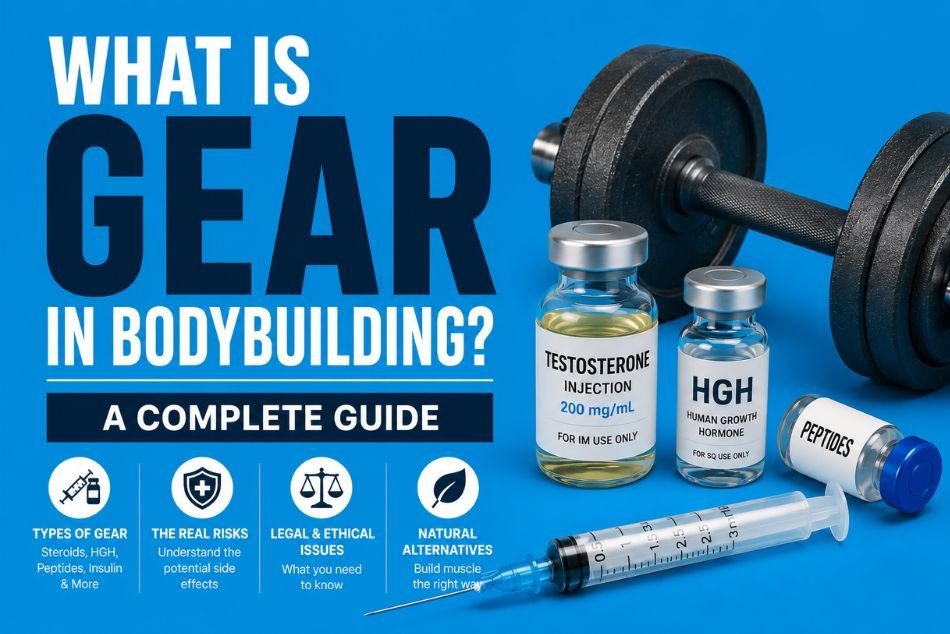
If you have spent any time around serious lifters or scrolled through bodybuilding forums, you have probably seen the word “gear” come up. So, what is gear in bodybuilding? It is a slang term for performance-enhancing drugs — most commonly anabolic steroids, human growth hormone (HGH), insulin, and other hormones or peptides used to push muscle growth and fat loss beyond what natural training allows.
The term is used casually in gym culture, often in ways that make it sound routine. But the substances it refers to are serious, carry real legal and health risks, and are banned across most competitive federations. This guide covers what gear is, why bodybuilders use it, how the different types work, what the research says about the risks, and what you can do instead if you are focused on building a strong, competitive physique the natural way.
Here, we believe in giving you the full picture — not a sanitized version. So here it is.
Why Do Bodybuilders Use Gear?
Bodybuilding at the elite level is not just about training hard. At some point, the conversation becomes about recovery, hormones, and how fast your body can rebuild muscle tissue. That is where gear enters the picture.
Anabolic compounds work primarily by binding to androgen receptors in muscle tissue. This triggers increased protein synthesis — meaning your muscles repair and grow faster after a hard training session. The practical result is that someone on gear can train more frequently, handle more volume, and recover in days rather than a full week.
Beyond just muscle growth, these substances help bodybuilders:
- Synthesize protein more efficiently, so every gram of food you eat works harder
- Boost red blood cell production, improving oxygen delivery to muscles during training
- Slash recovery times dramatically, allowing for more frequent and intense sessions
- Drop body fat while holding on to lean muscle mass, especially during a cut
That last point is the one that separates gear users from natural athletes most visibly. The ability to stay lean while holding full muscle bellies during contest prep is almost impossible without pharmaceutical help. Your body does not naturally like being shredded and muscular at the same time.
This is why gear is so common at the top levels of competitive bodybuilding. The competitive bar has been raised to a point where, for many professionals, it is viewed as a basic requirement rather than an unfair advantage.
Common Types of Gear in Bodybuilding
Gear is not one thing. It is an umbrella term for a range of substances. Here are the most common ones you will hear about.
Anabolic Steroids
These are synthetic versions of testosterone, the male sex hormone. They are the most widely used type of gear in bodybuilding by a significant margin.
Common anabolic steroids include Testosterone (in various ester forms), Dianabol (Methandrostenolone), Trenbolone, Nandrolone (Deca Durabolin), Anavar (Oxandrolone), and Winstrol (Stanozolol).
Some are taken orally, others via injection. Oral steroids tend to be harsher on the liver because they pass through it before reaching the bloodstream. Injectable forms bypass the liver initially, which is why they are generally considered less hepatotoxic, though not risk-free.
Bodybuilders typically run steroids in “cycles” — a set period of use followed by time off. The idea is to get the muscle-building benefit while giving the body’s hormonal system a break. Post-cycle therapy (PCT) is used afterward to help restore natural testosterone production.
Human Growth Hormone (HGH)
HGH is a naturally occurring hormone produced by the pituitary gland. It plays a role in cell regeneration, muscle growth, and fat metabolism. Synthetic HGH has been available as a prescription drug since the 1980s, and bodybuilders began using it shortly after.
Unlike steroids, HGH does not directly build muscle in the same aggressive way. Instead, it works by increasing levels of IGF-1 (Insulin-like Growth Factor 1), which then stimulates muscle cell growth and speeds up fat burning. HGH is popular during both bulking and cutting phases for exactly this reason.
It is also notoriously expensive and needs to be injected daily, often multiple times a day, to be effective.
Peptides
Peptides are short chains of amino acids that signal the body to do specific things. In bodybuilding, certain peptides are used to stimulate the release of growth hormone naturally. Common examples include GHRP-6 (Growth Hormone Releasing Peptide 6) and CJC-1295.
They are often used as a more affordable alternative to synthetic HGH, or stacked alongside it for a stronger effect. The research on peptides is still developing, and their long-term safety profile is not well established.
Insulin
Insulin is one of the most dangerous substances used in bodybuilding. It drives glucose and amino acids into muscle cells, which can significantly boost muscle growth when timed correctly around training.
The reason it is so risky is that a miscalculation in dosing can cause severe hypoglycemia — dangerously low blood sugar — which can lead to unconsciousness or death. There are documented cases of bodybuilders dying as a result of insulin misuse. It is not a substance to take lightly in any context.
SARMs (Selective Androgen Receptor Modulators)
SARMs are a newer class of compounds designed to selectively target androgen receptors in muscle and bone tissue while supposedly minimizing side effects on other organs. They are often marketed as a “safer” alternative to traditional steroids.
That claim is disputed. SARMs are not approved for human use by the FDA, they are banned in competitive sport, and the long-term safety data is limited. They are sold legally as “research chemicals” in many countries, which is a grey area in terms of legality.
The Legal Status of Gear
Anabolic steroids are classified as controlled substances in the United States under the Anabolic Steroids Control Act of 1990. Possession without a valid prescription is illegal and can result in criminal penalties. The legal situation varies by country — some countries allow personal use quantities, others do not.
In competitive bodybuilding, the picture is more complicated. Major organizations like the IFBB Pro League (which runs Mr. Olympia) do not test for PEDs, which is widely understood to mean that professional competitors at that level are using gear. Natural federations like the INBA, NPA, and others do test, though the reliability of testing varies.
If you compete naturally or plan to, it is worth understanding exactly what is banned and what the testing protocol is for your specific federation.
The Health Risks — What the Research Actually Says
This section matters. A lot of the information circulating in gym culture downplays the risks of gear, or frames them as manageable with the right protocols. The medical research tells a more serious story.
Cardiovascular Damage
This is the most well-documented and serious risk. Anabolic steroid use has been linked to left ventricular hypertrophy (thickening of the heart wall), reduced HDL cholesterol, elevated LDL cholesterol, high blood pressure, and accelerated atherosclerosis. In plain terms: a harder, less flexible heart and arteries clogged faster than they should be.
Multiple studies, including research published by the American College of Cardiology and in peer-reviewed journals, associate long-term AAS use with increased risk of heart attack, stroke, and fatal arrhythmias. Some of these effects persist even after a person stops using steroids.
Liver Damage
Oral anabolic steroids — particularly 17-alpha-alkylated compounds like Dianabol and Winstrol — are well-known for their hepatotoxicity. Research from UCSF found grade III and IV liver toxicity in men using oral steroids, and the National Institute on Drug Abuse (NIDA) documents cases of liver tumors and a rare condition called peliosis hepatis, where blood-filled cysts form in the liver and can rupture.
Injectable steroids carry lower liver risk but are not harmless. Regular monitoring of liver enzymes is considered standard practice among gear users for this reason.
Hormonal Disruption
When you introduce synthetic testosterone into your body, your natural hormone production responds by shutting down or reducing. The hypothalamic-pituitary-gonadal (HPG) axis gets suppressed. This means your testes produce less testosterone on their own, and in some cases shrink in size.
For many users, natural testosterone production recovers after cycling off. For others — particularly long-term or heavy users — it does not fully recover, and they end up needing testosterone replacement therapy (TRT) for the rest of their lives.
In women, anabolic steroid use can cause virilization — development of male characteristics including facial hair, voice deepening (Winstrol is particularly known for this), and menstrual irregularities. Some of these changes are irreversible.
Psychological Effects
Mood swings, increased aggression (the origin of the term “roid rage”), depression, and anxiety are all documented side effects of anabolic steroid use. The psychological effects tend to be more pronounced on certain compounds, with Trenbolone frequently cited as particularly harsh in this regard.
Dependency and withdrawal are also real concerns. Some users report a compulsive relationship with gear that is difficult to step back from, particularly when their identity is heavily tied to their physique.
Who Actually Uses Gear in Bodybuilding?
The honest answer is: more people than most gym-goers realize. When people ask what is gear in bodybuilding and who uses it, the assumption is usually professional competitors on stage. But usage is widespread at amateur and recreational levels too.
Research indicates that the typical steroid user today is not a professional athlete. They are more likely a recreational gym-goer in their 20s or 30s who wants to look better or compete at an amateur level. The availability of gear through online sources has made access far easier than it was two decades ago.
This is part of why understanding the risks properly matters. Decisions are being made by people without medical supervision, using substances that carry genuine long-term health consequences.
The Natural Alternative: What You Can Actually Achieve Without Gear
This is worth being direct about. If you train consistently for years, eat and sleep well, and dial in your programming, you can build a genuinely impressive physique. Not Mr. Olympia — but impressive.
Most men can expect to gain somewhere between 20 to 40 pounds of muscle over a serious multi-year training career, depending on genetics. That is a meaningful transformation. The problem is that social media, bodybuilding content, and fitness influencers have skewed expectations badly. A lot of what looks like “good genetics plus hard work” is actually gear.
The natural ceiling is real, but so is the room between where most people start and where it is. Good training, good nutrition, and smart recovery get you most of the way there.
What to Know Before Considering Gear
If you are an adult seriously weighing this decision, a few things are worth knowing before you make it.
- Blood work first: Get a full hormone panel and health markers before you start. Knowing your baseline is basic harm reduction.
- Medical supervision matters: Using gear without a doctor’s involvement means running blind. Liver enzymes, lipids, blood pressure — these need regular monitoring.
- You cannot out-train a bad cycle: Gear does not fix poor training or poor nutrition. It amplifies what you are already doing — good and bad.
- There is no completely safe dose: Some compounds and doses carry more risk than others, but the idea of a “safe” cycle is not supported by the medical literature.
- Legal implications vary by location: Know the laws in your country and state before purchasing or possessing anabolic steroids.
Wrapping Up
So, what is gear in bodybuilding? It is a broad category of performance-enhancing drugs — primarily anabolic steroids, HGH, peptides, and insulin — used to accelerate muscle growth, speed up recovery, and reduce body fat beyond what natural physiology allows.
Whether you are asking out of curiosity, trying to understand the competitive landscape, or weighing a decision about your own training, the important thing is to have accurate information. The risks documented in the medical literature are real. The legal implications are real. And the pressure to use, especially if you are competing or spending time in serious gym culture, can be significant.
Natural training, done consistently and intelligently over time, produces results that are worth pursuing. It takes longer. The ceiling is lower. But the health costs are not there, and the progress you build is yours to keep.
FAQs
Q1) Is Gear Used Only by Professional Bodybuilders?
No. Research and anecdotal evidence suggest that recreational gym-goers make up the majority of gear users today. Professional bodybuilders are the most visible users, but far from the only ones.
Q2) Can You Tell if Someone Is Using Gear Just by Looking at Them?
Not always. Some signs — like extreme muscle fullness alongside very low body fat, rapid transformation in a short time, or physical changes like skin texture and acne — can be indicators. But it is not a reliable method. Some people have very favorable genetics. Others are using gear and do not look the way you might expect.
Q3) What Does Post-Cycle Therapy (PCT) Involve?
PCT is a protocol used after a steroid cycle to help the body restore its natural testosterone production. Common PCT drugs include SERMs (Selective Estrogen Receptor Modulators) like Nolvadex (Tamoxifen) or Clomid (Clomiphene). The goal is to restart the HPG axis and prevent muscle loss during the period when natural testosterone is suppressed.
Q4) Are Natural Supplements a Real Alternative to Gear?
For muscle growth, supplements like creatine monohydrate, protein powder, and caffeine have solid evidence behind them. They will not replicate what anabolic steroids do, but they have a real and measurable impact on training performance and recovery. For natural athletes, optimizing these basics alongside training and nutrition is the approach that makes the most sense.
Q5) Can Women Use Gear Safely?
Women are significantly more sensitive to anabolic compounds than men due to lower natural androgen levels. Even small doses can cause virilization effects. Some female competitors use milder compounds like Anavar at low doses, but the risk of irreversible masculinizing side effects remains. This is not a decision to make without thorough research and, ideally, medical guidance.